
Today, content marketing is a major buzzword in the digital space, but many still misunderstand its true essence. Companies often treat it superficially, checking a box by posting pretty pictures on social media.
In reality, it is not just a supplementary promotional tool; it is a core business asset. It actively attracts, converts, and retains clients, significantly reducing reliance on expensive paid advertising channels.
In this guide, we will explore what content marketing truly is, its primary objectives, the best channels to leverage, and how to build a robust strategy to drive traffic and grow your business.
What is Content Marketing and Why Do You Need It?
Implementing a content strategy does not mean starting a blog simply because “everyone else is doing it.” It requires a systematic approach to creating texts, videos, podcasts, guides, and other formats with a clear goal: not just generating views, but driving tangible business growth. Content builds trust, clarifies your product’s value, and captures attention. It operates subtly, without aggressive sales pitches, yet it can generate more qualified leads than traditional paid channels.
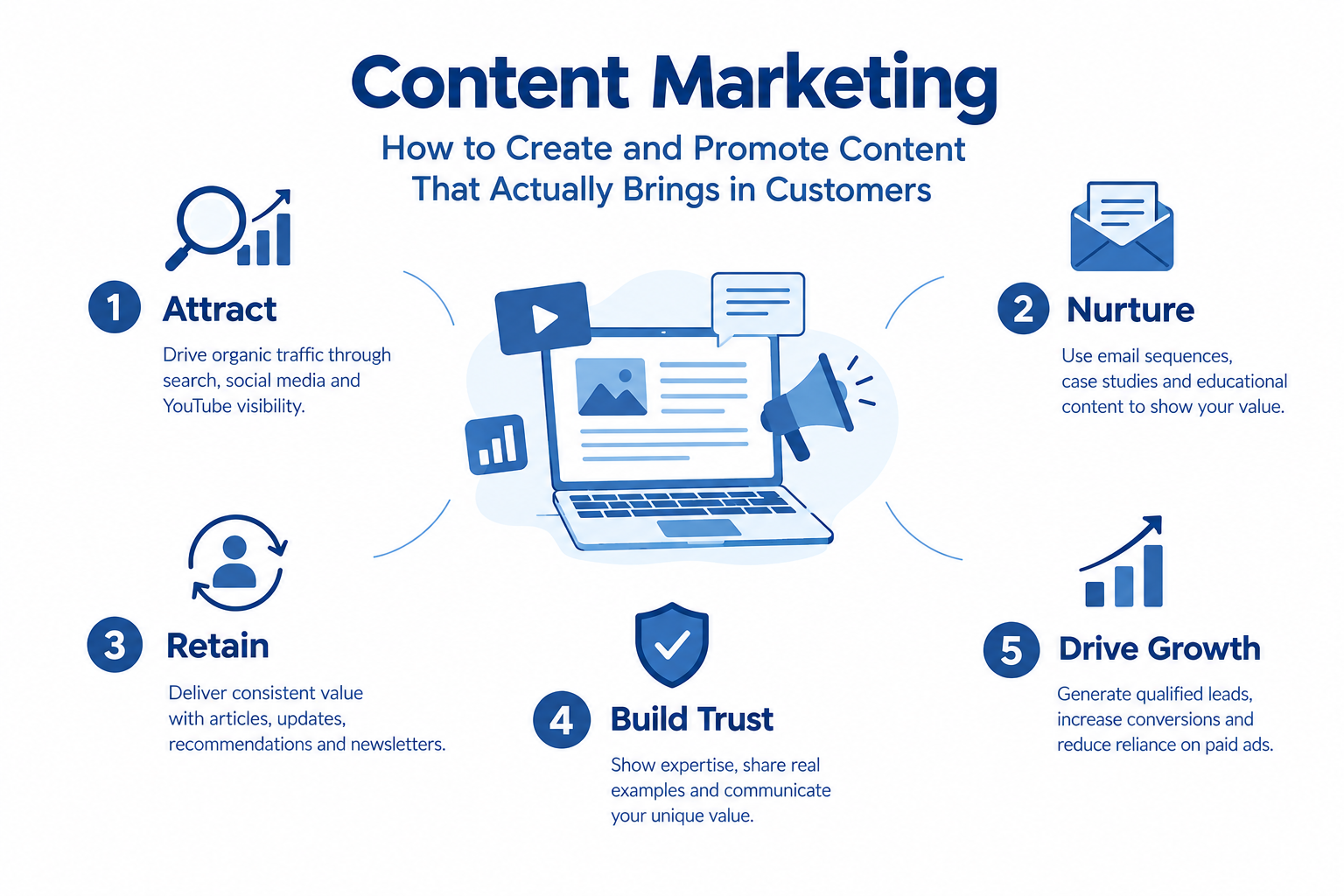
Content marketing addresses three fundamental objectives:
- Attraction: Driving organic traffic through search queries, social media shares, and YouTube visibility.
- Nurturing: Utilizing email sequences, case studies, and educational videos to help users understand your product and recognize its value.
- Retention: Delivering consistent value through regular articles, product updates, recommendations, and newsletters to keep clients engaged.
One of the most significant advantages is that content delivers long-term results. It can be scaled, repurposed, reintroduced in email campaigns, and utilized for retargeting. Most importantly, it does not require massive marketing budgets. Instead of burning cash on expensive clicks, you can start with a dozen highly targeted, valuable resources that hit the mark.
Where and How Content Marketing Works in Digital and Performance Marketing
Content marketing integrates seamlessly into performance marketing, info-business, e-commerce, and B2B models. In performance marketing, content is often used to warm up traffic for offers by explaining product mechanics or addressing audience pain points—for instance, through a Telegram channel, a mini-course, or a checklist. In e-commerce, it aids the decision-making process through curated collections, detailed reviews, and authentic testimonials. In B2B, it relies on expert articles and analytics to build credibility. In the info-business sector, content becomes the very core of the entire sales funnel.
Content thrives in environments where you need to explain, intrigue, or highlight value. However, it does not work well with direct, aggressive “hard sells.” For example, in performance marketing using a pre-landing page with a click-to-SMS mechanism, there is no room for substantial content because the user simply clicks and leaves. The same applies to clickbait teasers; if the content does not enhance the overall campaign, it is useless.
Effective content marketing does not replace advertising; it complements it, acting as a vital connecting link. It can warm up a cold retargeting audience, provide a reason for them to return, and extend the customer lifecycle—but only if it delivers the right information, in the right place, and in the appropriate format.
Primary Tasks and Goals of Content Marketing
Content marketing should not be dictated by fleeting trends; its purpose is to solve specific business problems. First and foremost, it boosts brand awareness and establishes authority. When your audience sees you not just as a store or an affiliate, but as a source of expert solutions, trust naturally increases. People read your articles, remember your brand, and return for more.
The second objective is lead and traffic generation. Articles, PDF guides, mini-courses, quizzes, and newsletters can capture inquiries and encourage action. The key is to properly integrate a lead magnet, a subscription form, or a retargeting pixel.
The third goal is customer retention through consistent value. Content marketing extends the user lifecycle: they remain subscribed to your channel, read your newsletters, and participate in community activities. This allows the business to secure more repeat interactions and sales.
Remember, these objectives do not exist in isolation. A successful strategy encompasses all three, aligning them with different stages of the funnel and various distribution channels. A poor strategy is limited to the mindset of “we write articles because we have to.”
Channels and Platforms for Content Marketing
In the digital landscape, content can be published anywhere, provided your target audience is present.
- Telegram: Currently the most versatile channel. It works exceptionally well for performance marketing, health and wellness, B2B, and info-business. You can build complex funnels, curate collections, and nurture leads with news and personalized content.
- Website Blogs: The foundation of SEO. A single well-optimized article can attract organic traffic for years. This is especially crucial for niches where users research extensively before purchasing, such as services, complex products, and IT solutions.
- Email Newsletters: Ideal for nurturing leads and driving repeat sales. You can automate sequences, segment audiences by interest, and deliver regular digests.
- YouTube and Reels/Shorts: Powerful formats for initial engagement and top-of-funnel awareness. Video often converts better than text when executed correctly.
- Social Media (VK, Instagram, Zen): The choice depends on your product. For some, these are primary channels; for others, they serve as supplementary showcase traffic.
A separate question arises: does a company absolutely need its own website? Yes, if you intend to leverage SEO, build complex funnels, establish credibility, capture leads, and archive your articles. However, if all your content lives on Telegram or YouTube and you do not rely on organic search, developing a website is not strictly mandatory. Even then, a simple site can serve as a traffic hub, a PDF catalog, or a dedicated landing page.
Formats and Types of Content
There is no universal recipe; everything depends on your objective, the funnel stage, and your business model. However, certain formats consistently deliver results.
Promotional and Engaging Content: Texts that gently guide users toward action:
- Landing pages
- Curated collections
- Quizzes
- Value-driven offers
These address specific customer pain points, such as “How to get fit for summer” or “5 affiliate offers with conversion rates above 7%.”
Expert and Educational Content: Valuable material that builds trust:
- Guides and manuals
- Case studies
- Step-by-step instructions
- Podcasts
- Webinars
- Reviews and product tests
- Infographics
- Glossaries and dictionaries
- Comparative articles
This works exceptionally well in B2B, performance marketing, and complex product niches. Example: “How to choose a dating affiliate network” or “Step-by-step analytics implementation in traffic arbitrage.”
Entertaining and Viral Content: Designed for mood and reach:
- Memes
- Storytelling
- Gossip-style segments like “Overheard from affiliate marketers”
While these formats rarely sell directly, they significantly boost engagement and brand recall.
Lead Magnets: Materials offered in exchange for contact information:
- Checklists
- PDF guides
- Excel templates
- Mini-courses
The key to success here is practical value. The more specific the user’s pain point, the higher the conversion rate.
Collections, Case Studies, and Digests: A favorite format for subscribers to “save for later.” This works for both beginners and experienced users. A curated list of tools, a breakdown of creatives, or a success/failure story with hard numbers strengthens your brand and establishes utility.
Do not fixate on a single type; mix and match your content formats. The same product can be explained in a guide, demonstrated in a case study, and sold via a PDF collection.
How to Build a Content Marketing Strategy
Content without a strategy is like a channel with zero subscribers. Here is a step-by-step algorithm for creating one:
- Define Your Target Audience: Who is your ideal client? What are their pain points and goals? What do they read, where do they spend their time, and what do they click on?
- Set Up Analytics and Choose KPIs: Do not limit yourself to vanity metrics like reach. It is crucial to track leads, repeat interactions, nurturing engagement, and other actionable data.
- Develop a Content Plan for at Least One Month: Ideally, plan for a quarter. Define formats, topics, dates, and platforms. The plan must remain flexible to capitalize on trends, seasonality, and campaign launches.
- Establish a Publishing and Distribution System: Determine where content will be published, who is responsible for posting, how it will be cross-posted, and who owns the results. You can automate this using tools like Amplifr, Buffer, Livedune, or a Notion + Telegram API integration.
- Implement Content Repurposing: A single comprehensive guide can later be transformed into 5 social media posts, 2 Reels, a downloadable PDF, and an email sequence. This saves resources and scales your reach.
A strategy is not just a buzzword to make workflows sound impressive. It is a living document that dictates action. Without measurable outcomes, your content will become a chaotic archive rather than a growth engine.
How to Promote Content and Drive Traffic
Even exceptional content will fail if no one sees it. Therefore, distribution is half the battle. Here are the methods used to promote content and attract traffic:
- Organic Search: The classic approach involving SEO-optimized articles, strategic keyword placement, and proper text structure. This yields stable, free traffic from search engines over time, though it requires patience and an understanding of search algorithms.
- Social Media: Platforms like Telegram, VKontakte, YouTube Shorts, TikTok, Facebook, and Instagram are ideal for fast-paced formats like posts, carousels, stories, and quick guides. It is vital to adapt the content to each platform’s unique format. You cannot simply copy and paste; you must repackage the message.
- Retargeting and Paid Ads: Often underestimated in performance marketing, retargeting users who have already read an article or clicked on a product yields excellent conversion rates. You can also run auto-targeting campaigns in Yandex Direct pointing to valuable content as a cost-effective way to reach a warm audience.
- Seeding (Guest Posting): Placing content in external blogs, channels, and newsletters. This is highly effective in B2B and info-business. It requires a budget but significantly boosts expertise and reach if the right audience is targeted.
- Budget-Friendly Methods: Commenting, cross-posting, and publishing answers or recommendations on platforms like Quora, Reddit, or Habr. Content can be cleverly wrapped into helpful advice.
- A/B Testing: Headlines determine much of the success. The exact same text with different titles can yield a 2% CTR or a 12% CTR. The same applies to formats: try a carousel instead of a long-read, or a video instead of a text guide. Metrics will reveal the most effective production approaches.
Methods for Evaluating Content Marketing Effectiveness
Content for the sake of content is a waste of resources. If you do not analyze performance metrics, you are simply burning budgets. Therefore, it is essential to track the following parameters:
- Behavioral Metrics: How much time did the user spend on the page? What percentage did they read? Where did they click? Did they watch the video to the end? These are indirect but crucial signals of engagement.
- Direct Metrics: Leads, subscriptions, inquiries, and clicks to offers. It is especially critical to track multi-channel interactions: a person might read an article but convert later via a retargeting ad. This is where UTM parameters, end-to-end analytics, and a CRM system become indispensable.
- Qualitative Feedback: Shares, comments, saves, and word-of-mouth. This is particularly evident on Telegram; if a post goes viral, it means you have struck a nerve with your target audience.
If you observe that your content is generating leads or warming up the audience to the point of inquiry, your strategy is working. If you are missing your targets, you are likely just posting pretty texts or videos without a clear objective, throwing efforts “into the void.”
Common Mistakes in Content Marketing
Many companies waste months and budgets due to basic blunders. Here are the key ones:
- Content Without a Goal: If there is no funnel and no understanding of why the material is being published, the result will be zero. An article written just to have an article will generate neither leads nor traffic.
Publishing “For Yourself”: This is especially common among specialists who write to showcase their own expertise but forget about the user.
- Content should not be about you; it must be for the client, solving their specific pain points or answering their questions.
- Lack of Analytics: Without data, it is impossible to know if the strategy is effective. Failing to connect web analytics, ignoring goal tracking, and not using UTM tags means the work is essentially pointless.
- Ignoring Platform Formats: The exact same text might perform brilliantly on a blog but fail miserably on Telegram. Content must be adapted to the specific platform, otherwise, CTR and reach will plummet.
- Inconsistency: A one-off effort like “we wrote an article and forgot about it” does not work. You need a consistent publishing system, a logical sequence, and repeated contact with your audience.
Conclusion
Content marketing is a tool not for creating pretty texts, but for building trust and expertise, which in turn drives sales. Even in performance marketing, where the habit is to push traffic directly, content can be integrated into campaigns to acquire warmer leads at a lower cost.
However, it is crucial to remember that only systematic content marketing yields results. You do not necessarily have to launch a blog, email sequences, and a YouTube channel all at once. It is enough to start small: one highly useful article will outperform a dozen useless posts.
Strong material lives for years, ranks well in search engines, reaches the top, and promotes itself. It is an asset that works without additional budget allocation. And that is the ultimate bonus of content.
FAQ
How does content marketing differ from targeted advertising? Targeted advertising works through direct propositions: “Buy now.” Content is a conversation with the audience, building trust and motivation. It is used in the early stages of the funnel: to attract, warm up, and retain clients. Often, different content formats work in tandem with ads.
Can I do without a blog? Yes, especially if your company’s focus is on social media or messengers. However, a website blog is a long-term asset: it aids SEO, provides stable organic traffic, and strengthens your brand’s search presence. Ideally, it is best to utilize all available channels and platforms for promotion.
How long does it take to see results? On average, 1 to 3 months. Content does not produce instant effects; it gains momentum gradually. It gets indexed, climbs in search rankings, and builds engagement. Initial leads may arrive sooner if you use the right distribution channels and appropriate formats.
Which formats are best to start with? If your budget is limited, begin with expert articles and guide-style posts. These are cost-effective, excellent for SEO, and great for attraction. Later, you can add curated collections, PDF lead magnets, videos, email sequences, and more.
How do I know if my content is working? If it brings in traffic, leads, subscriptions, inquiries, or an increase in direct brand searches, it is working. If an article just sits on your website with 10 views a month, your content marketing strategy is ineffective. Focus on real metrics, not just likes.