To succeed in performance marketing, you must thoroughly understand payment models, testing methodologies, and optimization techniques. Without a solid grasp of industry analytics terminology, the risk of wasting your advertising budget increases exponentially.
Beginners often get confused by the specialized jargon used by seasoned media buyers. A proper understanding of foundational terms helps you navigate the advertising landscape with confidence. Without this theoretical groundwork, staying afloat is nearly impossible. It is crucial to know the difference between an offer and a creative, or between CTR and ROI. If you want to feel secure in the traffic arbitrage industry, dedicate time to thoroughly studying these essential concepts.
What is Traffic Arbitrage?
Traffic arbitrage is a monetization strategy based on the margin between advertising expenses and the revenue generated from conversions. Simply put, you drive users to a specific promotional offer and earn a reward that exceeds your initial marketing costs.
The core idea is to purchase traffic intelligently and direct it toward the most suitable propositions. To do this effectively, mastering basic terminology is essential for building a sound strategy.
Many novices mistakenly believe that traffic arbitrage is merely buying and selling ads. In reality, it involves numerous nuances. You must deeply understand performance-based payment models, testing frameworks, and optimization tactics. Without comprehending analytics-related terms, the risk of draining your budget skyrockets.

Core Terminology and Definitions
Below is a list of fundamental keywords frequently encountered in performance marketing. Each entry serves as a starting point for a deeper dive into the subject.
GEO
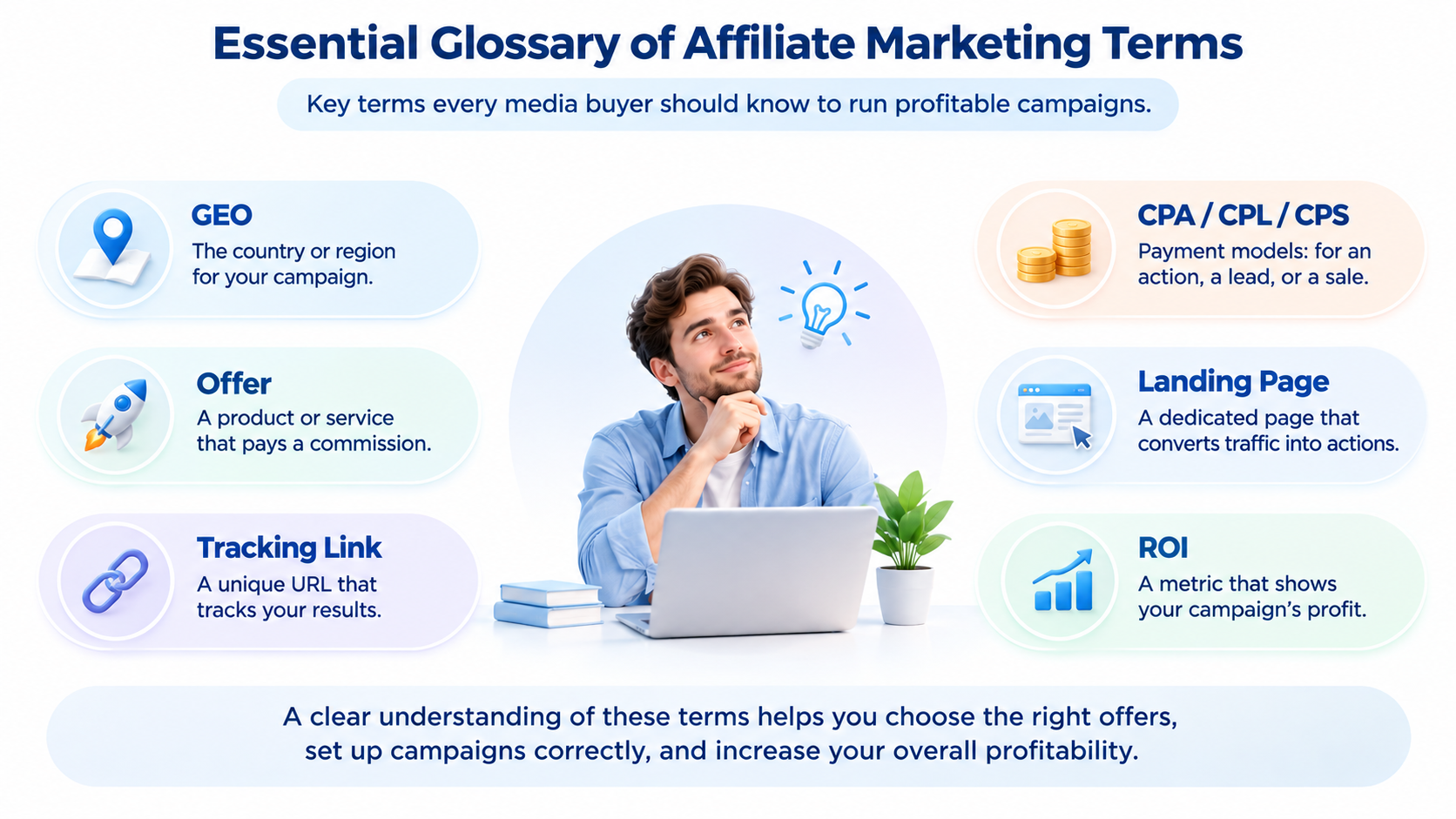
Short for “geolocation.” This term specifies the country or region where your advertising campaign is running. When selecting a GEO, consider local nuances and advertising regulations. For instance, certain offers convert exceptionally well in the United States, while others perform better in European markets. Analyzing GEO data helps you pinpoint where to achieve the best results.
Offer
This is a specific proposition from an advertiser, for which the affiliate earns a commission for every completed target action. An offer typically represents a product or service. The media buyer’s task is to discover and promote an attractive offer that resonates with the target demographic. When working with offers, always consider the conversion type, payment terms, and traffic requirements.
Cost Per Action
A payment model where the advertiser only pays when a specific, desired action is completed. Target actions can include registrations, purchases, or newsletter subscriptions. This performance-based model is one of the most popular in affiliate marketing. It benefits the advertiser significantly, as they only pay for actual, verified customers.
Cost Per Lead
A model where the affiliate is compensated for every new lead generated. A lead is typically defined as a user who submits their contact information. This model is common in niches where building a database of potential clients is crucial, such as financial services or educational programs.
Cost Per Sale
In this model, payouts occur only after a verified sale is completed. This approach requires high-quality audience warming. The media buyer must persuade the user not just to click the ad, but to actually purchase the product. However, the revenue per conversion is often substantially higher than in lead-generation models.
Affiliate Network
A platform that acts as an intermediary, connecting advertisers with publishers. This intermediary handles the technical infrastructure and provides a user-friendly interface for tracking performance. Affiliate networks simplify the media buyer’s workflow by offering a centralized hub with dozens of available offers. You can select a suitable offer and begin promoting it through your own traffic channels.
Tracking Link
A specialized URL embedded with unique parameters identifying the affiliate. Thanks to this link, the advertiser or network can trace exactly where the user originated. Without a tracking link, it is impossible to determine who should receive the commission. Always verify the accuracy of your tracking links before launching any campaign.
Landing Page
A dedicated web page designed specifically to receive incoming traffic. Its primary purpose is to captivate the visitor and encourage a specific target action. A high-converting landing page features a compelling headline, clear benefits, and a prominent call-to-action button. The success of an ad campaign often hinges on the quality of this page. A well-optimized landing page can multiply your conversion rates.
Creative
The visual or textual advertising material used to capture the audience’s attention. Creatives can take the form of text copy, static banners, video clips, or animations. The main goal is to intrigue the user and provoke a click on the advertisement. A successful creative is the cornerstone of high conversion rates. You will often need to test multiple variations to discover the most effective one.
Targeting
The process of configuring your advertisements to display exclusively to a highly specific audience segment. You can filter users by demographics such as gender, age, interests, and location. Precise targeting increases the likelihood that your ad reaches a relevant audience. By utilizing accurate settings, you minimize the risk of wasted budget and maximize your return on investment.
ROI (Return on Investment)
This metric indicates the profitability of your campaign relative to the budget spent. The calculation is straightforward: (Net Profit – Total Expenses) / Total Expenses × 100%. If you invest $100 and generate $120 in revenue, your ROI is 20%. Monitoring ROI is essential for evaluating campaign efficiency and making timely adjustments.
CTR (Click-Through Rate)
This metric measures the clickability of an advertisement. It is calculated as: (Total Clicks / Total Impressions) × 100%. CTR reveals how appealing your ad is to viewers. A higher CTR generally indicates a more relevant and engaging creative. However, a high CTR does not automatically guarantee a high conversion rate. Many people may click, but few may ultimately purchase.
EPC (Earnings Per Click)
The average revenue generated from a single click. It is calculated by dividing the total campaign profit by the total number of clicks. EPC helps you evaluate the profitability of a specific offer and traffic source combination. If the EPC is too low, it might be time to change your ad format or target a different audience.
Conversion
The moment a user completes a desired step within your marketing funnel. While conversion often means a purchase, it can also refer to a registration, subscription, or any other predefined action. The conversion rate is a primary indicator of campaign effectiveness. To boost conversions, continuously optimize your landing pages, refine your creatives, and sharpen your targeting.
Hold Period
The timeframe during which the network or advertiser verifies the quality of the incoming traffic. This period ensures that the recorded conversions are legitimate and not fraudulent. If no violations are detected, the commission is credited to your account. Hold periods can range from a few days to several weeks, depending on the specific rules of the affiliate network or offer.
White, Gray, and Black Hat Methods
These terms describe different approaches to traffic generation and promotion. White hat methods are official, permitted, and ethical. Gray hat methods operate in a legal gray area, pushing the boundaries of platform rules. Black hat methods are strictly prohibited and involve outright deception of users. Your choice of strategy depends on your goals and risk tolerance. Beginners are strongly advised to start with white hat methods to avoid account bans.
Whitelist and Blacklist
Whitelist: A curated list of websites or placements where your ads perform exceptionally well. Blacklist: A list of placements that either fail to generate results or deliver low-quality, fraudulent traffic. When working with banner networks or targeted campaigns, maintaining these lists is crucial. Regularly updating your whitelists and blacklists ensures optimal budget allocation.
Traffic Source
The specific platform or channel through which you attract users. Common sources include social media platforms, search engine ads, banner networks, and push notification services. Sometimes, marketers utilize multiple channels simultaneously to scale results and discover the optimal traffic mix. Each source has unique configuration requirements and cost-per-click dynamics.
Ad Account
The administrative profile used to launch and manage your advertising campaigns. Different social networks and advertising platforms require separate ad accounts. Successful media buyers typically maintain multiple accounts to avoid reliance on a single channel. These are also used to circumvent potential platform blocks or budget restrictions.
Pixel
A small snippet of code installed on a website to monitor visitor behavior. Pixels are used to gather statistics, optimize for conversions, and build lookalike audiences. The more precise the collected data, the easier it is to enhance ad performance. Pixels are particularly vital when running campaigns on platforms like Facebook Ads or similar networks.
Funnel
The sequential journey a user takes from their first interaction with your brand to the final target action. In traffic arbitrage, a funnel might consist of a pre-landing page, a lead capture form, an email sequence, and a final sales pitch. The objective is to minimize user drop-off at every stage. A well-crafted funnel significantly increases the probability of a successful conversion.
Upsell and Downsell
Upsell: Encouraging a customer to purchase a more expensive or premium version of a product. Downsell: Offering a more budget-friendly alternative if the user declines the primary offer. Both mechanisms are designed to increase the average order value. Media buyers frequently employ these techniques to maximize overall profitability.
Split Test (A/B Testing)
The process of evaluating different variations of a single campaign element. For example, you might test different headlines, images, or call-to-action buttons. The goal is to identify which variant yields the highest conversion rate. Split testing is vital for discovering optimal settings and creatives. Consistent testing is the key to sustained performance growth.
Cookie
A small data file stored in the user’s browser. Cookies track which pages a person has visited and which items they have added to their shopping cart. In traffic arbitrage, this is highly useful for retargeting. You can “follow” the user across other advertising sources, encouraging them to return and complete their purchase.
Cloaking
A technology that displays different content to the advertising platform’s moderation bots than to real users. Cloaking is widely used in gray and black hat schemes to bypass moderation rules. However, these tactics are highly risky: advertising platforms actively combat cloaking by banning accounts and domains.
Pre-landing Page
An intermediary page designed to “warm up” the user before directing them to the main landing page. It typically highlights the product’s benefits or prepares the visitor for the core proposition. A pre-landing page can significantly boost conversion rates by ensuring the user understands the value before reaching the final destination.
Bid Limit
The maximum amount you are willing to pay for a single click or impression. In auction-based advertising systems, your bid influences the frequency and placement of your ad. A bid that is too low may result in your ad rarely being shown. A bid that is too high will drain your budget rapidly. Finding the optimal bid level is a core task for every media buyer.
Lead Magnet
A valuable, free product or service offered to users in exchange for their contact information. This could be a free e-book, access to an exclusive webinar, or a software trial. A strong lead magnet increases registration rates, allowing you to market your primary product to them later.
External and Internal Bridge Pages
Sometimes, marketers insert multiple intermediary pages (bridges) between the initial ad and the final offer. These help further warm up the user or bypass strict moderation. An external bridge might mimic a news portal or blog, while an internal bridge could resemble an expert’s personal recommendation page.
Sub-accounts (SubID)
Additional parameters appended to a tracking link for granular analytics. SubIDs allow you to pinpoint exactly which specific ad creative or placement generated a conversion. They are indispensable when running multiple creatives and GEOs simultaneously, enabling rapid identification of the most profitable combinations.
Direct vs. Paid Traffic
Direct traffic consists of users who manually type a website address or use a saved bookmark. Paid traffic consists of users who arrive via advertisements. In traffic arbitrage, the primary focus is on paid channels, as scaling profit organically through direct traffic alone is exceptionally difficult.
Backend
All the processes that occur “behind the scenes” after the user completes the initial target action. This includes follow-up email sequences, sales team phone calls, and cross-sell offers. A well-structured backend can substantially increase the lifetime value of each customer. Beginners often underestimate this phase, missing out on significant additional revenue.
Bounce Rate
The percentage of visitors who leave a webpage almost immediately without taking any action. A high bounce rate usually indicates that the page content or the ad creative failed to meet user expectations. You may need to revise the landing page copy, improve the design, or adjust the offer to retain audience attention longer.
Lookalike Audience
A demographic segment automatically generated by an advertising platform based on the behavior of your existing converters. The system identifies new users with similar characteristics and interests. Lookalike audiences are excellent for scaling campaigns, as they expose your ads to a highly receptive public.
Retargeting
A strategy that allows you to display ads specifically to individuals who have previously interacted with your content. For instance, if someone visited your landing page but did not purchase, retargeting will “follow” them on social media or other websites. This increases the likelihood that the user will return and complete the desired action.
Lead Nurturing
The process of gradually warming up a contact until they are ready to make a purchase. This involves sequential emails, chatbot interactions, and other engagement mechanics. The more complex the product, the more critical it is to nurture the lead by providing relevant information in an accessible format.
Media Buying
The practice of purchasing advertising space on third-party platforms or networks. Media buying involves negotiating favorable terms and placing banner or native advertisements. In traffic arbitrage, media buyers constantly analyze performance data while managing substantial budgets. Media buying is often synonymous with arbitrage, as the core objective is identical: acquire traffic cheaply and monetize it at a higher value.
Contextual Advertising (PPC)
Advertisements displayed on search engines and partner websites based on the user’s specific search queries. The Pay-Per-Click (PPC) model requires payment only when a user clicks the ad. Success in contextual advertising relies heavily on precise keyword selection, negative keyword lists, and careful budget management.
Native Advertising
An ad format designed to blend seamlessly with the surrounding content of a website or platform. Users often do not immediately recognize it as an advertisement, perceiving it instead as organic content. Native ads are effective because they avoid triggering ad blindness. However, maintaining the right balance between genuine value and commercial intent is crucial.
Push Notifications
Brief messages that appear on a user’s browser or mobile device screen. Push advertising frequently yields strong results in arbitrage because the messages are highly visible and difficult to ignore. However, a major drawback is that uninteresting notifications are easily dismissed or permanently blocked by the user.
Email Marketing
A channel that utilizes email sequences to attract and retain customers. In traffic arbitrage, email marketing often serves as a component of the broader funnel, where you “warm up” a lead before the primary sales pitch. Well-crafted email chains significantly boost conversion rates, especially for offers that require detailed explanation.
Test Budget
The specific amount of money allocated to validate a hypothesis: determining whether an offer is viable for a chosen traffic source or creative. It is vital to recognize that without testing, you cannot obtain objective performance data. Experienced media buyers always define a strict financial limit for testing to prevent draining their entire bankroll.
Optimization
The ongoing process of refining advertising campaigns based on empirical data. You optimize creatives, landing pages, targeting parameters, and other variables. If a particular traffic source yields no conversions, you pause it. If a specific creative achieves a high CTR, you allocate more budget to it. Optimization is a continuous cycle aimed at achieving maximum profit margins.
Scaling
The process of expanding campaigns that have already proven their profitability. You can scale by increasing the daily budget, expanding into new GEOs, or broadening the target audience. However, during scaling, it is critical to monitor that the conversion rate does not degrade. A common novice mistake is blindly pouring more money into a campaign without verifying the ongoing quality of the incoming traffic.
Anti-fraud Systems
Services designed to detect fraudulent traffic or malicious activity. Media buyers must understand how anti-fraud mechanisms operate to avoid forfeited payouts. If a network determines that your conversions are artificially inflated, you may lose your earnings. Therefore, always monitor traffic quality and strictly adhere to platform guidelines.
Cash Flow
The movement of money in and out of your business operations. Traffic arbitrage involves continuous upfront advertising expenditures, with profits returning slightly later. Consequently, it is crucial to monitor your account balance and maintain a financial reserve. Otherwise, you might miss out on a highly profitable offer simply due to a lack of available funds.
Multi-accounting
The practice of operating multiple accounts within a single advertising network. This can be a legitimate strategy when managing distinct projects. Alternatively, it can be a gray hat tactic used to circumvent platform restrictions. Remember that advertising platforms aggressively combat malicious multi-accounting. If one account is banned, associated accounts may also be frozen.
Roadblocking
A strategy where you attempt to dominate a specific advertising space entirely, preventing competitors from entering. This approach typically requires massive budgets. While not always practical for beginners, it can occasionally help secure a dominant position in a highly profitable niche.
Holdout Testing
An evaluation method where a specific segment of your traffic or audience is deliberately excluded from receiving your advertising offer. By comparing the conversion rates of this control group against the exposed group, you can measure the true incremental impact of your ads. This is a more advanced alternative to traditional split testing.
Conditionally Free Traffic
A method of attracting visitors that does not require direct monetary expenditure on advertisements. The primary investment here is your time, effort in producing high-quality content, and strategic resource optimization. When executed correctly, this approach can generate a stable, long-term stream of targeted visitors, reducing your reliance on paid advertising channels.
Traffic Shifting
The technique of redirecting already acquired traffic between different offers or landing pages. Shifting helps optimize overall conversion rates by funneling visitors toward the propositions that demonstrate the strongest performance metrics. Media buyers use this approach to maximize revenue: if one offer shows declining conversions, the traffic can be seamlessly rerouted to a more effective alternative, lowering costs and boosting ROI.
Proxy
An intermediary server that masks your device’s actual IP address from the external world. Proxies allow you to simulate connections from various global regions, which is especially important when running campaigns targeted at specific countries or cities. Utilizing high-quality proxy servers helps prevent the linking of multiple accounts, ensures stable connectivity, and supports accurate campaign tracking.
Anti-detect Browser
A specialized software tool designed to mask your device’s digital fingerprint. Anti-detect browsers alter data regarding your browser type, operating system, screen resolution, and other hardware characteristics. This allows you to manage multiple advertising accounts simultaneously without the risk of them being linked together. Thanks to this tool, media buyers can bypass anti-fraud systems and maintain anonymity while launching campaigns across different regions and offers.
Spy Service
An analytical platform used to monitor competitors’ advertising campaigns and study market trends. Spy services aggregate data on creatives, traffic sources, budgets, and conversion rates, enabling you to rapidly adjust your own promotional strategy. Utilizing these tools helps you discover winning case studies, test innovative approaches, and enhance the overall efficiency of your campaigns.
Why Mastering This Terminology Matters
Understanding fundamental terminology is a foundational requirement for success in performance marketing. Without this knowledge, you cannot accurately analyze statistics, select promising offers, or adapt to market shifts. Ignorance of basic concepts frequently leads to poor decision-making and financial loss. The more precisely you understand professional jargon, the easier it becomes to negotiate with advertisers and affiliate networks.
Many successful media buying teams dedicate specific resources to training newcomers on terminology. This accelerates the onboarding process, reduces operational errors, and builds professional confidence.
If you feel you are missing critical details, revisit the core concepts listed above. Let this glossary serve as your personal reference guide, ready to be consulted whenever doubts arise.
Configuring targeting parameters, selecting the appropriate payment model (Cost Per Lead, Cost Per Sale, or Cost Per Action), analyzing conversions, and managing funnels all demand familiarity with these terms. Otherwise, communicating with network managers or interpreting their recommendations will be incredibly difficult. Furthermore, much of traffic arbitrage revolves around statistical analysis. Without comprehending metrics like CTR, EPC, and ROI, it is impossible to gauge your campaign’s success. Every term is a vital cog in a larger, interconnected mechanism.
The market continuously introduces new advertising formats, automation tools, and analytical solutions. However, the foundational concepts remain constant. These are the very building blocks upon which the entire traffic arbitrage ecosystem is constructed.
If you aspire to grow professionally, study emerging trends, but never neglect the basics. Knowing the terminology is what separates a novice guessing in the dark from an expert making calculated, data-driven decisions.
Conclusion
Traffic arbitrage is not merely about buying ads for a quick, short-term profit. It involves market analysis, the ability to select suitable offers, and the precise calibration of targeting parameters. To launch with confidence, you must speak the language of this industry. The fundamental terms we have explored will help you navigate the most critical aspects of the business. Without them, you will be operating blindly and unnecessarily risking your capital.
Each term possesses its own depth. For example, ROI is not just a mathematical formula; it is the cornerstone of financial campaign analysis. A creative is not just an image; it is a psychological tool designed to influence user behavior. Hold periods, offers, funnels, and whitelists are all interconnected links in a single chain. By understanding how they interact, you can construct highly effective advertising sequences. The ultimate result will be substantial income and unwavering confidence in your capabilities.
Keep this glossary of terms readily accessible. Market demands and queries are constantly evolving, innovations emerge, and moderation rules change. However, if you have mastered the foundational knowledge, adapting to new tools and strategies will be significantly easier.