Before diving into spy tools and scrolling through hundreds of banners, ask yourself a simple question: why exactly do I need to find advertising creatives?
If your answer is simply “to have something to launch,” you are already setting yourself up for financial loss. The goal isn’t just to “find a picture.” The real objective is to discover a winning combination, which consists of:
- The angle: The specific message and emotion you use to engage the user.
- The offer: What exactly you are promoting (brand, product, or promotion).
- The packaging: The visuals and copy that present the message.
- The entry point: Where the user encounters the ad and how they are prompted to react.
You are not looking for a random image; you are searching for the underlying logic that has already proven its effectiveness in the market.
Therefore, finding a creative actually means:
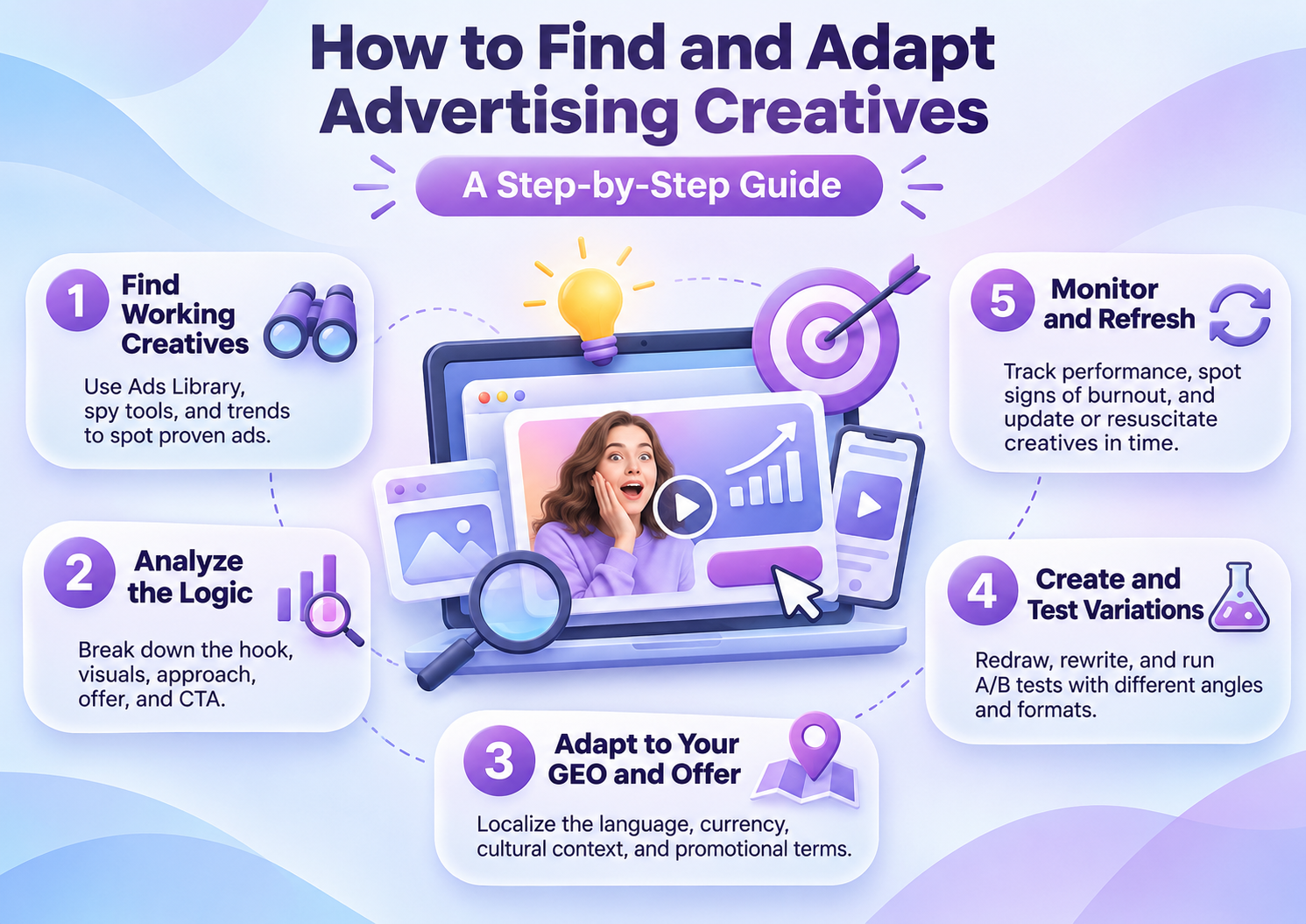
- Analyzing what and how others are currently launching.
- Understanding the psychological reasons why it might work.
- Extracting the core structural elements.
- Adapting those elements to your specific GEO, offer, and target audience.
- Only then redrawing, rewriting, and testing.
If you simply copy someone else’s banner, you will always be one step behind. But if you understand why it worked, you can launch your own winning combination before your competitors even catch on.
(Note: Always ensure you have the rights or use original adaptations of any creative concepts you develop.)

Finding Advertising Creatives: A Step-by-Step Approach Used by Media Buyers
Opening Ads Library and typing a generic term like “software” is not a search strategy; it is a lottery. Here is how a normal, systematic approach to finding creatives actually yields results:
Define the GEO and Language
Advertising tailored for Germany will not perform the same way in India. Example: In Brazil, emotional creatives featuring live reactions and social proof perform exceptionally well. In Kazakhstan, news-feed style creatives tend to convert better for local services.
Search platforms must be configured strictly for the target country and language. Without this precise targeting, you will miss the mark.
In Ads Library, set the following filters:
- GEO: The exact region you are targeting.
- Launch date: Restrict to the last 30 days only.
- Platform: Facebook / Instagram.
Look for Angles, Not Just Offers
Here are the queries media buyers start with (instead of generic, broad terms):
- “Welcome discount”
- “Start your free trial online”
- “Achieve real results”
- “Claim a 30-day free trial”
- Specific brand names: “Top industry brands”
Do not fixate on the banners themselves. Focus on the core angle of the approach: Is this advertising through scarcity? Through FOMO (Fear Of Missing Out)? Through a news format? Through a current event? Through a personal success story?
Noticed a great angle? Write it down separately. Not the banner itself, but the underlying approach. It will come in handy later when you adapt it to your own offer.
Identify the Dominating Formats
As of 2026, the dominant formats include:
- Videos up to 15 seconds (TikTok-style, especially effective for Tier-2 GEOs).
- Personal case stories (“I just signed up and transformed my workflow…”).
- News-style formats (they work, but must be used with caution and transparency).
- Screenshots + emotion (e.g., a dashboard screenshot showing massive growth paired with a shocked facial expression).
Look for what repeats across different campaigns—that repetition indicates a working format.
Do Not Trust Likes; Look at Lifespan
If a creative has been actively running for 2+ weeks without changes, it is delivering results. No media buyer keeps an unprofitable campaign running on Facebook.
This is the ultimate filter for junk: Launch date + duration of life > any number of likes or reposts.
Analyzing Competitors’ Creatives and Extracting Their Essence
You found a banner that has been running for two weeks, gathered over 1 million impressions, and looks highly engaging. What is next? No, do not drag it into Photoshop yet. First, you need to break it down into its core components.
Here is the universal structure of any creative that you must learn to read:
Headline or First Frame: The “Hook”
Ask yourself: What is grabbing attention right here?
It could be:
- A specific number: “+200% growth in your first month”
- A strong emotion: “I saw these results and was completely blown away”
- Intrigue: “Everyone is doing this, but no one talks about why”
- A local trigger: “A new tool just launched in your city”
For example, in competitive niches, the hook is most often built around saving money, reducing risk, or the exact moment of success. You need to learn to identify and capture this.
Visuals: Image, Face, Emotion
Look not only at the picture, but analyze:
- Composition: Is the face on the left and the text on the right?
- Colors: Are they neutral or highly saturated/acidic?
- Use of simulated elements (dashboard screenshots, app interfaces).
- Is there “movement”? (arrows, flashes, subtle animations).
In some regions, faces with clear, exaggerated expressions currently work well: surprise, excitement, shock. In others, clean animations paired with bold numbers are still highly effective.
The Core Approach: How It Engages the User
This is the most critical element. Every creative has an underlying idea it is built upon. Here are a few examples:
| Approach Type | Example from Creative |
| Social proof | “He just tried it—and grew revenue by 320%” |
| Secret trick | “A workflow hack competitors don’t know about” |
| Local news event | “A resident of Samara finally optimized their system” |
| Risk-free start | “30-day free trial with no credit card required” |
Your task is to understand exactly which of these approaches was utilized, and then rewrite it to fit your own brand and target GEO.
Call to Action (CTA)
Pay close attention to:
- Is there a clear button or text overlay?
- What is the specific call: “Start now”? “Test your luck”? “Register today”?
- Is there a deadline or limitation mentioned? This psychological trigger significantly boosts conversion.
If you simply copy the creative, platforms like Facebook or TikTok will immediately restrict your reach or ban the account. But if you preserve the structure (hook + visual + approach + CTA) and redraw everything from scratch, it becomes a brand new creative, backed by proven logic.
How to Make an Advertising Creative for Your Specific GEO, Offer, and Format
Finding a successful creative is only the beginning. If you run it exactly as you found it, the CTR will be lower, moderation might reject it, and users won’t click because the visual “doesn’t feel like it’s for them.” Therefore:
Failing to adapt means wasting your advertising budget.
Here is how to do it correctly:
Adapt to the GEO
Check if the following elements are suitable:
- Language (not just the headline, but also text on buttons, screenshots, and interfaces).
- Currency (do not use $ or € in Kazakhstan—use Tenge).
- Names, cities, and local realities (do not write “John from London” when targeting Argentina).
If you are targeting LatAm, phrases like this work exceptionally well: “¡No necesitas experiencia! Empieza a ganar desde casa.” (You don’t need experience! Start earning from home.)
If targeting Eastern Europe, bonus-focused formulations are more effective: “Sign up now and get a 30-day free trial immediately.”
In one offer, the hook might be registration without a credit card; in another, it might be “subscription from $10”. Ensure your approach does not mislead the user. If you promise a “free trial with no credit card,” but a card is actually required, you will be criticized in the comments, and your CTR will plummet.
Verify the following:
- Does the offer have an active promotional deal?
- Is identity verification required?
- Are there welcome bonuses available?
- Can you legally use real brand names (sometimes you cannot, so you must simulate them)?
Match the Format to the Platform
The exact same creative cannot work equally well on TikTok, Facebook Ads, and push notification networks.
Here is how to adapt:
| Platform | What Works | What Doesn’t Work |
| TikTok | Vertical video up to 15 sec, UGC (User-Generated Content) style | Glossy, highly produced banners, static slideshows |
| 1:1 video or banner + clear CTA | No text overlays, lack of subtitles | |
| Push Networks | Clickable headline + strong provocation | Long texts, lack of intrigue or urgency |
Winning Formula for TikTok:
- First 2 seconds: grab attention immediately.
- 3–5 seconds: demonstrate the core value.
- 5–10 seconds: showcase the result or emotional reaction.
- 11–15 seconds: clear call to action and visual button.
Verification and Launch
Before launching:
- Run it through anti-fraud filters (especially crucial in competitive niches!).
- Check spelling and grammar—yes, this affects trust scores.
- Conduct A/B tests with 2–3 variations of angles and hooks.
- Prepare for moderation: adapt the creative separately to comply with Facebook or TikTok rules.
When Targeted Advertising Creatives Stop Working: Signs of Burnout and What to Do Next
Every creative—even the highest-converting one—has a finite lifespan. This is not a bug; it is a normal market dynamic.
User fatigue, frequent impressions, and banner blindness will eventually kill even the most excellent banner or video.
How to Tell If a Creative Has Burned Out
Here are clear, measurable signals to diagnose this:
| Sign | What It Means |
| CTR starts dropping steadily | Users have already seen the creative and are no longer reacting to it. |
| Frequency metric > 2.0 | The same person sees the ad 2–3 times—a clear sign of audience “wearout”. |
| Cost per lead / click increases | Platform algorithms recognize that users are not engaging, raising your costs. |
| Comments like “you again” | The audience is overheated and actively rejecting the message. |
If at least two of these signs appear, you must urgently test new approaches.
What to Do When a Creative Burns Out
- Change the approach. If you were using “free trial with no credit card,” try a case study angle: “How a guy from Perm saved 120 hours in just 3 days.”
- Change the creative, but keep the logic. You do not necessarily have to change the underlying approach; you can simply update the visual, convert a static banner into a video, or change the actor’s face in the frame.
- Add or remove urgency. If there was no deadline, add one: “Offer valid only until the end of the week.” If there was already urgency, remove it and replace it with emotion or social proof.
- Segment your audience. Divide your audiences: new users vs. retargeting, men vs. women, 18–24 vs. 25–45. The same creative will perform differently across these distinct groups.
How to “Resuscitate” a Creative
Sometimes, a simple tweak is all it takes:
- Add bold subtitles to the video.
- Change the color palette (especially effective for static images).
- Make the CTA more aggressive or direct.
- Shorten the video clip to 7–8 seconds.
- Reformulate the headline (incorporating FOMO, social proof, or a clear benefit).
Do not permanently delete old combinations. Sometimes they perform well again after 1–2 months, especially when launched in a new GEO or after an offer update.
Where to Find Advertising Creative Examples in 2026: Services, Libraries, and Unconventional Sources
Opening a spy tool and typing a generic term is not a strategy. It is a path into an abyss of contextless creatives. Below are proven sources where you can actually find working creatives, and how to utilize them.
Meta Ads Library
Best for Facebook and Instagram.
- What to search: Enter specific brand names or key phrases like “discount”, “free trial”, “get started”.
- Set filters: Country, launch date, format (image/video).
- How to use: Analyze the creative + accompanying text + CTA. Track exactly how many days it has been running. The longer it runs, the more stable and profitable the result.
Ads Library is not just about Facebook; it provides a clear window into the campaign’s overall approach and logic.
Spy Services: AdHeart, BigSpy, Anstrex, PowerAdSpy
Best for systematic, large-scale analysis.
| Service | What It Provides | Key Features |
| AdHeart | FB, IG, TikTok, Push, Native | Can search by language, brand, or specific offer |
| BigSpy | Facebook, Instagram, TikTok, YouTube Ads | Includes a dedicated e-commerce database, videos, and images |
| Anstrex | Native + Push networks | Highly convenient for spying on push notification creatives |
| PowerAdSpy | Videos, banners with detailed performance stats | User-friendly interface, though on the expensive side |
When searching, look for:
- New creatives (launched within the last 7 days).
- Those utilizing repeating, proven formulas.
- Those being scaled across multiple GEOs simultaneously.
Unconventional Methods
If you want to stay one step ahead of the competition:
- Check the ads yourself: Register for the offer, allow yourself to be retargeted, and observe exactly what ads chase you.
- Test TikTok Trends: Monitor which videos are trending under hashtags like #productivity, #tools, #hustle, or #earnings.
- Use browser extensions like AdSpy Chrome Extension: These allow you to view live ads directly in your social media feed in real time.
Creating Advertising Creatives Based on What You Found: A Step-by-Step Checklist
A working creative is not merely one that looks aesthetically pleasing, but one that:
- Grabs attention instantly.
- Clearly demonstrates value.
- Evokes a strong emotion.
- Prompts immediate action.
Here is how to step-by-step turn any found creative into your own, unique asset, built upon a proven combination.
Write Down the Structure of the Original Creative
Look past the picture and analyze the construction:
| Element | Example from Someone Else’s Creative |
| Hook | “He just signed up…” |
| Visual | Dashboard screenshot + shocked facial expression |
| Approach | Personal story, quick efficiency gains |
| Offer | 30-day free trial with no credit card |
| Call to Action | “Try it right now” |
This breakdown becomes your skeleton, which you can now customize.
Come Up with YOUR Own Angle Using the Same Approach
Suppose your chosen approach is a “personal story.” You can present it in a completely different way:
Original: “He just signed up—and grew revenue by 320%”
Your Version: “At 3 AM, he got a notification: +320% growth on his dashboard”
This is already a different headline and a different entry angle, but it relies on the exact same proven psychological approach.
Remove All Obvious Signs of Plagiarism
- Redraw all visual elements from scratch.
- Change the colors and overall style (if the original was black and gold, make yours light and minimalist).
- If the original used a stock face, replace it with authentic UGC, or better yet, record your own video with a custom voice-over.
A simple way to stand out is to use a combination of two angles. For example: “A resident of Samara (local news event) + 30-day free trial (risk-free entry).”
Choose the Correct Format for the Platform
| Platform | Format | Key Features |
| TikTok | Vertical video | No brand logos, under 15 seconds, minimal heavy editing |
| Video or 1:1 banner | Must include a CTA, preferably with subtitles | |
| Push Networks | Headline + icon + text | Under 45 characters, strong psychological trigger, no brand name |
Assemble the Creative
Utilize these tools:
- Canva: For rapid graphic design.
- CapCut: For editing TikTok-style videos.
- VEED.IO: If you need to generate automatic subtitles.
- Remini: For upscaling faces or backgrounds.
- Generated Photos: To obtain unique, AI-generated faces (avoiding moderation flags).
- Text-to-Speech tools: For professional voice-overs.
Check Against the Pre-Launch Checklist
- Adapted specifically to the required GEO.
- Contains a clear, specific psychological approach.
- Free of blatant copy-paste elements.
- Features a clearly formulated offer.
- Includes a clear and motivating CTA.
- Visually stands out in a crowded feed.
How NOT to Search for and Use Creatives: Mistakes That Kill Results
Understanding what not to do is just as important as following the correct algorithm. Below are common mistakes, frequently made even by experienced media buyers.
Mistake 1: Copied a creative—and immediately went to launch it.
- Why it’s bad: You do not know the GEO, offer, or target audience segment it was originally applied to. Your CTR might be 0.1%—not because the creative is inherently bad, but because you failed to adapt it to your specific situation.
- How to do it right: Always adapt, at a minimum, by language, currency, local realities, and psychological approach.
Mistake 2: Searching in only one source.
- Why it’s bad: If you only look at Meta Ads Library or only at AdHeart, you get a heavily distorted picture. For example, TikTok has entirely different trends than push notification networks.
- How to do it right: Monitor 3–4 sources regularly, comparing frequency, variety of formats, and GEO-specific adaptations.
Mistake 3: Not tracking the creative’s lifespan.
- Why it’s bad: A burned-out creative will not save even the best offer. If your frequency is > 2 and CTR is dropping, you are actively losing money every single day.
- How to do it right: Set up a tracking funnel for each creative, monitoring CTR, CPC, and engagement metrics over time.
Mistake 4: Thinking visuals are the most important element.
- Why it’s bad: Visuals are only half the battle. The other half is the approach and delivery. The exact same banner can work dozens of times more effectively if the headline contains a powerful hook.
- How to do it right: Test different combinations: run the same banner with completely different headlines and calls to action.
Mistake 5: Using creatives without considering platform moderation rules.
- Why it’s bad: TikTok, Meta, VK, and even Telegram Ads have strict, distinct rules. Videos explicitly showing unrealistic earnings or displaying restricted brand logos will easily get your account banned.
- How to do it right: Create two versions—a white (compliant) one for initial moderation and a black (aggressive) one for after approval (if permitted by the offer and platform rules). Alternatively, use compliant white pre-landers.
Mistake 6: Not understanding what you are actually seeing in spy services.
- Why it’s bad: A popular creative does not automatically equal an effective one. It might be running on a broad, unoptimized cap, used purely for branding, or simply spamming the network.
- How to do it right: Look past the likes. Focus on the launch date, frequency of repetition, and whether creatives with the same underlying logic are being used by multiple different marketers—this is a true sign that the combination is genuinely profitable.
Conclusion
Searching for creatives is not a mundane technical routine, nor is it about blindly copying others’ solutions. It is a fundamental part of a media buyer’s systematic workflow, where it is crucial not only to “see” and “download,” but to deeply understand why the creative works, in what specific context it is launched, and how to adapt it to your unique task.
To truly master the art of finding and utilizing creatives with maximum benefit:
- Connect multiple data sources: from spy services and ad libraries to real-world examples on social media.
- Analyze not just the picture, but the logic of delivery, the psychological approach, the format, and the offer.
- Always adapt your assets to the specific platform, GEO, and behavioral patterns of your audience.
- Test extensively, but systematically—always knowing exactly which hypotheses you are validating.
No list of services or “top” rankings will help if you do not treat the creative as the most critical element of your conversion funnel. If you know how to find the right angle, recognize patterns in competitors’ advertising strategies, and build your own campaigns competently, you will always have working creatives that deliver consistent, profitable results.