Opening a website, launching ads, and writing a couple of articles—yet inquiries are still absent. Familiar? In 2026, the rules of the game have shifted: search engine algorithms can now distinguish useful content from templated text, advertising has become more expensive, and social networks suppress organic reach without a budget. Acting blindly will simply drain financial resources.
This guide explores how to promote a website without unnecessary expenses or wasted time: which channels genuinely bring clients to small and medium-sized businesses, how much to allocate in the initial budget, and which trends to consider right now. It demonstrates a step-by-step approach—from niche analysis to the first results—enabling an independent launch or competent supervision of a contractor.
Let us proceed in order, starting with the foundation, without which even the best channels will fail.
Briefly
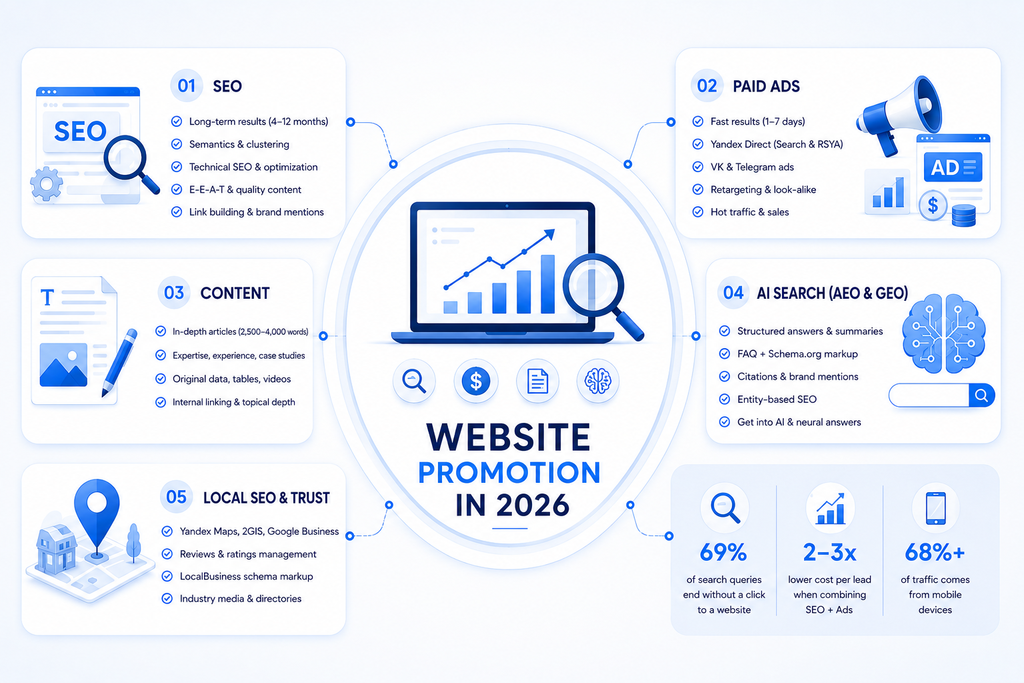
- Website promotion in 2026 relies on a combination of channels: SEO delivers inexpensive traffic within 6–12 months, contextual ads in Yandex Direct generate inquiries within days, and together they reduce the cost per lead by 2–3 times.
- Initial budget for small businesses: SEO — 30,000–80,000 RUB/month, contextual ads — 40,000–150,000 RUB/month, social media targeting — 20,000–60,000 RUB/month, email newsletters — from 3,000 RUB/month.
- In 2026, 69% of search queries conclude without a click to a website, making it critical to optimize content for AEO and GEO: structured answers, FAQ blocks with Schema.org, and mentions on trusted platforms like VC.ru and Habr.
- Ranking requires content of 2,500–4,000 words with E-E-A-T signals: an author page with credentials, links to primary sources, and Person and Article microdata markup—especially in YMYL topics.
- Manipulating behavioral factors via bots leads to a domain ban in Yandex for 8–12 months, while mass link purchasing on exchanges results in the Minusinsk filter and position loss.
Where to start: Goals, audience, and website type
Promoting a website without clear objectives and audience understanding burns the budget: one pays for traffic that does not convert into inquiries and for rankings on queries that do not generate revenue. Before investing the first ruble in SEO or advertising, three elements must be fixed: a measurable goal, a visitor profile, and the resource type, because the strategy for an online store and a blog differs fundamentally.
Setting goals and KPIs
Define what constitutes success and tie it to numbers: monthly target traffic volume, number of leads, cost per lead (CPL), and return on marketing investment (ROMI). For a commercial project, the benchmark is usually inquiries and sales; for media, it is reach and view depth. Without KPIs, it is impossible to determine if a channel is effective, leading to continued payment out of inertia.
Strategy based on website type
The approach to web resource promotion changes based on its purpose:
- Landing page — narrow semantic core, focus on contextual advertising and conversion, with SEO playing a supporting role.
- Online store — massive processing of product cards and categories, commercial factors (prices, delivery, reviews), and feeds for marketplaces and product ads.
- Blog or content project — informational semantics, regular publications, internal linking, and behavioral factors.
- Corporate website — brand reputation, regional service pages, expert content, and trust.
Starting point audit
Before promoting a website, check the foundation: page indexing in Yandex and Google, loading speed, mobile adaptation, presence of meta tags and Schema.org microdata, current positions, and traffic sources in analytics systems. Simultaneously, gather data on niche competitors—which queries they rank for and their link mass. This provides a realistic baseline and highlights which tasks to address first.
Comparison of promotion channels: Budget, timelines, complexity
Choosing a channel without comparison is the primary reason for wasted budgets. The same shoe store might recoup SEO promotion in six months or generate sales within a week via contextual advertising—the difference in cost per acquisition can reach 5–10 times. Therefore, before launching, it is useful to lay out all website promotion methods and compare them across four parameters: entry cost, time to results, complexity threshold, and traffic type.
| Channel | Starting budget, RUB/month | When results appear | Complexity for beginners | Traffic type |
| SEO promotion | 30,000–80,000 | 4–8 months | High | Warm, targeted |
| Contextual advertising | 40,000–150,000 | 1–7 days | Medium | Hot |
| Social media targeting | 20,000–60,000 | 2–4 weeks | Medium | Cold, interest-based |
| SMM (organic) | 15,000–50,000 | 3–6 months | Medium | Loyal |
| Email newsletters | 3,000–15,000 | 1–2 weeks | Low | Returning |
| Content marketing | 25,000–70,000 | 6–12 months | High | Informational |
| Crowd marketing | 10,000–30,000 | 2–5 months | Low | Cold, with trust |
These figures represent approximate ranges for small and medium businesses: actual rates in Direct, SEO hourly costs, and link-building prices depend on the niche and region. Therefore, always request estimates from two or three contractors and compare them with your own margin before launching.
SEO suits projects with a long horizon: services, online stores, informational portals. Contextual ads are the choice for those needing sales yesterday: new offers, niche tests, seasonal promotions. Targeting works for products with impulse demand and visual presentation. Organic SMM is for brands where loyalty and repeated touchpoints matter. Email pays off when a database already exists. Content marketing builds expert authority but requires patience. Crowd marketing is a good SEO supplement—providing link mass and mentions.
Combining SEO and contextual advertising yields maximum synergy: contextual ads cover the first few months while the site climbs the rankings, simultaneously accumulating behavioral signals and search engine trust. Once SEO takes off, the contextual budget can be cut by 2–3 times, as organic search works for free.
SEO promotion: Semantics, optimization, technical aspects
SEO is a 6–12 month endeavor that reduces reliance on paid traffic. The cost per click in Direct rises every season, whereas organic traffic after reaching the top brings visitors for free—the return on such an investment is calculated over years.
Collection and clustering of the semantic core
The semantic core is a list of queries for which pages are prepared. Start with the free Yandex Wordstat: enter 5–10 basic phrases of your theme and export the frequency. Next, there are two paths. Bukvarix (has a free version) provides a quick, extended list without deep analytics. Key Collector is a paid desktop tool for serious work: it parses suggestions, cleans junk, and groups queries by intent.
After collection, cluster the queries: one page per group of closely related phrases. Informational queries (“how to choose a sofa”) go to the blog, while commercial queries (“buy a sofa in Kazan”) go to product cards and categories. Part of the routine—clustering, meta-tag generation, semantics expansion—is delegated to neural networks for SEO, saving dozens of hours at the start.
Internal page optimization
Once the cluster is gathered, a page is prepared for it. Title — up to 60 characters, main query near the beginning, brand at the end. Description — 150–160 characters, with a call to action and USP (this is not a ranking factor, but it affects CTR in search results). One H1 per page, duplicating the title’s meaning without exact repetition. H2-H3 divide the content into subtopics and also include keys from the cluster.
Human-readable URLs (site.ru/sofas/corner/, not site.ru/?id=4521) are the norm for 2026. Internal linking: from each blog article, include 2–3 links to commercial pages using relevant anchor text.
Technical foundation
Without technical setup, the rest fails. Control list:
| Parameter | Norm |
| Protocol | HTTPS is mandatory |
| Loading speed (LCP) | up to 2.5 seconds |
| Mobile adaptation | responsive design |
| robots.txt | service sections are closed |
| sitemap.xml | auto-generation, updates upon publication |
Mobile adaptation is critical: according to Mediascope data for 2025, the share of mobile traffic in Russia exceeded 68%, and this share continues to grow. If a site displays poorly on a phone, indexing by Yandex’s mobile bot will be problematic, and positions will be low.
Microdata markup and search widgets
Schema.org is markup that explains data structure to the search engine: product, price, rating, FAQ, recipe, organization. In Yandex, marked-up pages appear in search widgets—expanded result blocks with stars, prices, and images. Studies show that adding rich snippets increases CTR by 25–35% compared to a standard result line.
Minimum for a commercial site: Organization markup (on the homepage), Product + Offer (on product cards), BreadcrumbList (breadcrumbs), FAQPage (on pages with questions).
Page SEO readiness checklist
- query cluster gathered, frequency verified
- unique meta tags title and description
- one H1, logical H2-H3 hierarchy
- human-readable URL, incoming links from other pages
- alt tags on all images
- Schema.org markup implemented and valid
- page loads in under 2.5 seconds on mobile
Content marketing and E-E-A-T: How to write to rank
Content marketing in 2026 is the foundation of both SEO and AEO simultaneously: the same materials attract visitors from Yandex search and simultaneously appear in AI overview and neural search answers. Algorithms have learned to distinguish useful content from a mere rewrite of the top 10, so simply rewriting competitors no longer works—original data, experience, and closed gaps are required.
Analysis of competitors’ content gaps
Content gaps are topics and subtopics missing from the top search results but sought by your audience. Gather the semantic core via Wordstat and Keys.so, export the top 10 articles for main queries, and compare their tables of contents. Sub-queries present in suggestions and “People also ask” but not covered by competitors are your priority. Add to this questions from reviews, forums, and comments—this is where real pain points live, which SEO texts usually ignore.
E-E-A-T and author verification
E-E-A-T (Experience, Expertise, Authoritativeness, Trustworthiness) is checked by Google through entities and connections: who the author is, where else they publish, and if credentials are verified. For YMYL topics (medicine, finance, law), this is critical—without a specified author with a bio and relevant education, an article has almost no chance of reaching the top. Minimum on the site: an author page with a photo, title, links to LinkedIn and professional publications, material update date, and links to primary sources—studies, GOSTs, official documents. Yandex reads the same signals via Schema.org microdata (Person, Article, author).
Formats that work in 2026
Comprehensive guides of 2,500–4,000 words with clear structure, case studies with specific numbers (“revenue grew from 1.2 to 3.8 million in 4 months”), comparison tables, and 2–3 minute video inserts within the text rank best. Short SEO notes of 800 words generate almost no traffic—they are displaced by AI answers directly in the search results, and according to CNews, referral traffic decreased by a quarter in the first half of 2025.
Links, mentions, and crowd marketing
Links and mentions remain authority signals, but the logic has changed: search engines evaluate entities, brand-topic connections, and mention context. Bare link mass without meaning no longer works—what matters is who speaks about you and in what context.
Quality donors versus exchanges. Look at three things: domain trust and age, thematic proximity to your niche, and the donor’s actual search traffic. A platform with DR 60 but zero visitors and a catalog of “articles on any topic” is junk. Mass purchasing of backlinks on exchanges for pennies almost guarantees Minusinsk filters and Google spam signals. Five live donors per month are better than fifty templated ones.
Crowd, guest posts, and PR. Crowd marketing involves answering on specialized forums, review sites, thematic communities, and Reddit-like platforms. The goal is not just a link, but a live transition and brand mention in a natural context. Guest publications in industry media provide both traffic and trust. Unanchored mentions (just the company name without a hyperlink) are also counted—search engines link the brand to the topic through entities.
Directories and aggregators. Yandex.Business, 2GIS, Google Business Profile, and industry directories (for lawyers, doctors, repair services, etc.) are a mandatory base for local and commercial promotion. They cover maps, reviews, and part of the transactional demand without advertising investments.
AEO, GEO, and neural search: A new layer of promotion in 2026
Neural search in 2026 is no longer an experiment but a separate traffic channel: users ask ChatGPT, YandexGPT, Alice, and Perplexity directly and often do not reach the classic search results. Research indicates that 69% of queries now conclude without a website click—up from 56% a year ago. If a website is absent from neural network answers, it loses the audience that previously clicked on organic results.
What are AEO and GEO in simple terms
AEO (Answer Engine Optimization) is optimization for answer engines: Alice, voice assistants, quick answer blocks. The goal is to provide a ready-made answer in 40–60 words that the machine can read aloud entirely. GEO (Generative Engine Optimization) is optimization for generative models like YandexGPT and ChatGPT, which compile answers from multiple sources and decide whom to cite.
How to get into neural network answers
A combination of four elements works:
- structured answers at the beginning of the article—a direct answer to the question before expanding on the topic;
- FAQ blocks with Schema.org FAQPage microdata markup;
- citability: the more often your data is retold by other sites, the higher the chance of appearing in neural network results;
- brand mentions on trusted platforms—RBC, VC.ru, specialized media, Habr, industry directories.
Neural networks rely on source consensus. One site with a unique figure loses to ten sites that reference each other.
Entity-based SEO: The website as an entity
Yandex algorithms and language models work not with pages, but with entities—connections between a brand, people, products, and topics. Register the brand in Wikidata, design the “About company” page with facts (founding year, team, licenses), and use Organization and sameAs microdata markup with links to social networks and directories. This helps the model understand who you are and in which topic you are an expert.
Monitoring brand mentions in AI answers
Once a month, ask ChatGPT, YandexGPT, and Perplexity questions like “best services for [your niche]” and note how your brand is described. If data is outdated or distorted, update the primary sources: website, directory cards, articles on VC.ru. Models retrain, and the picture changes in 2–3 months.
Paid promotion: Contextual, targeted, and retargeting ads
Paid traffic is justified when immediate results are needed: niche testing, sales, new product launches, or SEO backup in the first six months. The main benchmark is ROMI: calculate the margin per order, divide by advertising expenses, and if the indicator goes negative for two to three consecutive months, the combination is not working.
Yandex direct: Search versus RSYA (ad network)
Search advertising captures hot demand—a person has already typed “buy a coffee machine,” and you compete for the click via bid and ad quality. Contextual advertising in RSYA works differently: impressions occur on partner sites based on interests, catching those who are just browsing. Search is more expensive but converts better; RSYA is cheaper and warms up the audience well. Yandex Direct is usually launched in combination—search for sales, RSYA for reach and upselling.
Targeting in VK and Telegram ads
Targeted advertising in VK suits B2C with a clear audience profile: age, interests, subscriptions to competitor communities. Telegram Ads is a format of short ads in channels, with a minimum budget of a few hundred euros, yet the audience is solvent and loyal to content. According to Sostav, Telegram’s audience has grown to over 85 million active users, now comparable to VKontakte’s reach.
Retargeting
Without retargeting, one pays for clicks twice. Bring back those who visited the site but did not submit an inquiry: abandoned cart, product card view, tariff page visit.
Local SEO, social networks, and behavioral signals
Local SEO and website usability work often bring inquiries faster than classic top-ranking promotion for broad queries: one competes not with the entire runet, but with five to ten companies within a district radius, and behavioral factors weigh more here than formal optimization.
Local SEO: Maps, reviews, geo-queries
Create cards in Yandex.Maps and 2GIS, filling out all fields—hours, photos, services, prices. A card with 20+ fresh reviews and a rating of 4.5 outranks a competitor’s website for geo-dependent queries like “dentist nearby” or “coffee shop in Chertanovo”. On the website, duplicate the address, phone, and hours identically everywhere, and add LocalBusiness microdata markup via Schema.org—this helps Yandex algorithms link the page to a physical location.
Social networks and Telegram as a source of traffic and behavioral factors
A Telegram channel and VKontakte community provide two effects: direct targeted traffic via links and an indirect signal—transitions from bookmarks, direct brand visits, read-throughs. These are the behavioral factors that algorithms read as a sign of a quality resource. Publish not just product announcements, but breakdowns, case studies, and answers to audience pain points—this increases the share of website transitions.
Gamification: Quizzes, calculators, configurators
A quiz like “we will pick a tariff in 5 questions,” a repair cost calculator, or a kitchen configurator keeps a visitor for 3–5 minutes instead of 30 seconds. This increases view depth, reduces bounce rates, and noticeably grows conversion. According to a case study in “Delo” magazine, replacing a standard form with a quiz increased conversion almost threefold—from 3.2% to 8.5%, while lead quality also improved.
Risks, filters, and black-hat methods to avoid
One mistake in promotion can nullify a year of work: the site drops from the top, loses traffic, and takes months to recover. Below is what is truly dangerous and how to react.
Behavioral factor manipulation. Simulating transitions and clicks via exchanges and bots is the fastest way to lose a host. Yandex bans the entire domain, and according to Rush Analytics, the restriction period for simulating user actions can range from 8 to 12 months. Recovery via domain change resets accumulated age and link mass.
Yandex filters. Minusinsk hits sites with mass purchased SEO links and a poor donor profile. Baden-Baden catches text over-optimization: key spam, “buy cheap in Moscow” footers, unnatural anchors.
Google filters. Penguin reacts to manipulative link profiles, Panda to thin and duplicate content. Currently, both algorithms operate in real-time within the search core, so waiting for separate “updates” is unnecessary.
What to do if filtered. Record the drop date and cross-check with Webmaster and Search Console messages. Remove the cause: disavow bad links, rewrite over-optimized texts, dilute the anchor list. After corrections, submit the site for review and wait for the next update—from two weeks to several months.
Analytics: How to understand if promotion is working
Without analytics, promotion becomes shooting in the dark: budget is spent, but it is unclear which channel brings clients and which only burns money. Analytics connects search positions with actual revenue.
Basic stack: What to install first
The minimum for any project is Yandex.Metrica and Google Analytics 4 for user behavior, plus Yandex.Webmaster and Google Search Console for the site’s technical state and search visibility. This is enough to see traffic, indexing, and the queries bringing visitors.
Metrics by funnel stages
Move top to bottom: positions by semantic core → organic traffic → inquiries and calls → sales → ROMI (return on marketing investment). If positions grow but there are no leads, the problem lies in usability or commercial factors, not SEO.
When to adjust the strategy
Check traffic and behavioral metrics monthly, and money and ROMI by channel quarterly. A channel with negative profitability for two consecutive quarters is a candidate for rebuilding or disconnection.
Conclusion
Website promotion in 2026 is not a choice between SEO and contextual ads, but the assembly of a multi-channel system tailored to specific business goals. First, understand the audience and website type, then close the basics: semantics, technical setup, and E-E-A-T-based content. Layer on links, local SEO, paid traffic, and neural search adaptation (AEO/GEO). Without analytics, all this becomes budget waste, so set up metrics before launching, not after.
Select 2–3 channels from the article that best fit the website and budget, list 5 initial tasks for each, and put them in the plan for the next month—this is enough to start and see the first numbers in analytics within 30 days.
Frequently asked questions
How much does website promotion cost in 2026? The budget depends on the channel and niche. SEO for small businesses usually starts from 40,000–80,000 rubles per month when working with an agency or private specialist. Contextual advertising in Yandex Direct is calculated by cost per click and fluctuates greatly—from a few rubles in informational topics to several thousand in legal and medical fields. Free methods (content, social networks, crowd marketing) require only time but yield results noticeably slower.
Can a website be promoted for free? Yes, this is a viable path if there is time and effort. Free channels include organic SEO, blog management, social networks, thematic directories, crowd marketing on forums and Q&A platforms, and email newsletters. A realistic timeframe for the first tangible results is 4–6 months, and for stable target traffic, about a year.
Where to start promoting a new website? First, a technical audit: loading speed, mobile adaptation, correct meta tags, absence of broken links and duplicates. Then, gather the semantic core, distribute queries across pages, and perform basic internal optimization. After this, connect the site to Yandex.Webmaster and Google Search Console to monitor indexing and launch a regular content plan.
How does SEO differ from contextual advertising? SEO is a long-term investment in organic search results: traffic continues even after work stops, but top positions take months to appear. Contextual ads in Direct or Google Ads deliver clicks on the launch day, but once the budget ends, traffic drops to zero. A sound strategy combines both: use context to cover immediate demand, and grow SEO as the main channel.
How long does SEO promotion take? Initial shifts for low-frequency queries are visible 2–3 months after work begins. Stable top-10 positions for medium- and high-frequency keys appear on average in 6–12 months. In highly competitive niches (finance, real estate, medicine), the horizon shifts even further—up to a year and a half.
What are AEO and GEO optimization? AEO (Answer Engine Optimization) is optimizing content for direct search engine answers: quick answer blocks, featured snippets, voice search. GEO (Generative Engine Optimization) is preparing a site for citation in generative systems: ChatGPT, YandexGPT, Perplexity, Google AI Overviews. They differ from classic SEO in that the goal is not a link click, but getting the fact or quote itself into the AI answer.
How to get into neural network answers like ChatGPT and YandexGPT? Create structured content with clear definitions, numbers, and short factual formulations—neural networks find this easier to cite. Add FAQ blocks, lists, tables, and mark up pages via Schema.org. Simultaneously, work on brand mentions on trusted platforms: Wikipedia, industry media, aggregators—models more frequently reference sources already present in their training data.
What Yandex filters threaten improper promotion? Minusinsk is applied for purchasing low-quality SEO links. Baden-Baden catches key spam in text and meta tags. AGS lowers sites with thin, duplicated, or poorly generated content. For behavioral factor manipulation via bots or click exchanges, a site may face severe sanctions up to complete exclusion from search results.
How to promote an online store versus a blog? In a store, commercial factors decide: wide assortment, real reviews, detailed product cards with specs and photos, convenient filters, clear delivery and payment terms. In a blog, the focus is on informational semantics, expert long-reads, authorship, and E-E-A-T signals—author bio, source links, expert mentions in external publications. Usability and speed are critical in both, but growth points differ.
Can one independently push a website to the top without a specialist? In low- and medium-competitive niches, it is quite realistic, especially in local business, narrow B2B segments, and niche hobbies. It requires time to learn the basics: semantics, technical audit, working with Webmaster and Search Console, and a basic understanding of link mass and behavioral factors. In highly competitive topics, doing it alone is unfeasible—a team is needed: an SEO specialist, copywriter, developer, and link builder.